
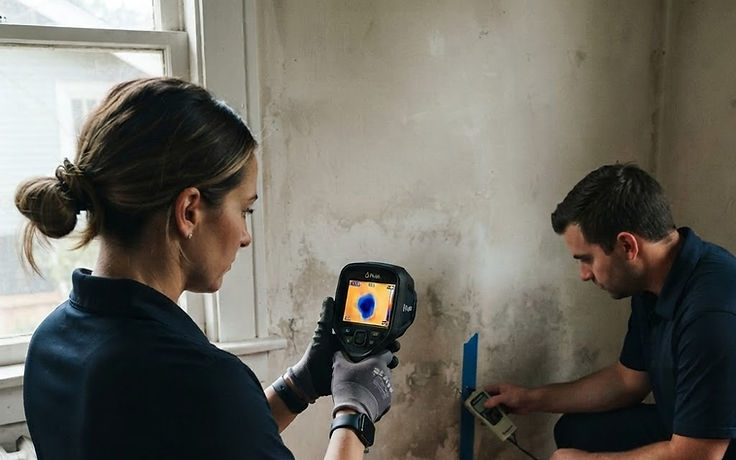
Water is patient. It travels inside wall cavities, along joists, behind baseboard and under flooring, and the visible stain is usually not where the leak is. Thermal imaging is how we stop guessing.
What the camera actually shows
A wet material evaporates, and evaporation absorbs heat, so the surface reads cooler than the dry material beside it. An infrared camera renders that difference as a temperature map. It does not measure moisture directly; it shows anomalies, which we then confirm with a meter. That two-step is what makes the finding defensible in a claim file.
When it changes the outcome
- Finding a supply leak that is 15 feet from the stain and saving a whole kitchen demolition.
- Defining the true boundary of a wet ceiling, so extraction and drying equipment are sized correctly.
- Checking for water inside exterior walls after wind-driven rain, where there is no visible evidence at all.
- Confirming that a structure is dry at the end of a job, which is what closes out the equipment charges.
How a camera sees water you cannot
An infrared camera reads surface temperature, not moisture. Wet material evaporates, and evaporation cools the surface, so a wet patch of drywall shows up cooler than the dry board beside it. That is the entire trick. The camera does not prove water is there; it shows where to put the meter.
That distinction matters when reading a report. A cold spot behind a wall could be water, a stud, a duct, a missing bat of insulation or an air leak. A competent technician uses the camera to find candidates and the pin meter to confirm them, and reports both.
Where the camera earns its keep
- Ceilings below a bathroom or laundry, where the drywall looks dry but the assembly is wet.
- Slab on grade, where water has travelled under tile and the only sign is a cool patch.
- Exterior walls after a wind-driven rain event, to find where water entered and how far it went.
- Around a failed appliance, to establish the full footprint rather than just the visible puddle.
- Post-drying verification, to catch a cold pocket the meters missed on the visible surfaces.
Does an insurance company accept thermal images?
Yes, widely, because they are objective and time-stamped. What carriers want is the image paired with a meter reading and a room label, not a gallery of coloured pictures. We deliver both in the same report.
Can I do this myself?
A phone-attached thermal camera is genuinely useful for spotting a candidate, and it is not a substitute for a pin meter or a moisture map. If you see a cold pattern, the value is in calling for a reading rather than in opening the wall on the strength of a colour.
What the images in your report should include
A thermal image with no reference is decoration. What makes it evidence is the pairing: the same framing with a visible-light photo, a room label, a timestamp, and a pin meter reading at the same spot. With those four things, an adjuster can see that a cold patch is water rather than a stud, and a reviewer two months later can find the same spot in the room.
The other thing to look for is a scale. A useful report states the temperature range on the image and the difference between the anomaly and the surrounding surface. A 6 degree differential on drywall above a wet ceiling is a strong indication; a 1 degree differential in a cold room is a camera artefact, and an honest report says so.
Where images are used to justify demolition, they should be taken before the demolition, not reconstructed from memory after. That is the standard we hold ourselves to, and it is a fair thing to ask any company for.
What the camera cannot do
A thermal camera cannot see through a stud, a shelf of books or a closed cabinet door with contents against it. It also cannot distinguish water from a cold air leak, a missing bat of insulation or a shadow cast by furniture. And it cannot tell you how wet something is: a damp wall and a soaked wall can look identical on screen because evaporation, not saturation, sets the surface temperature.
That is why a scan is followed by a meter at every candidate spot, and why the report shows both. A company that hands over thermal pictures with no readings attached is showing you a map without a legend.
Diagnostic visits across Seattle: 425 390 5911.
- Water damage
- Thermal imaging
- Seattle
- Diagnostics

