
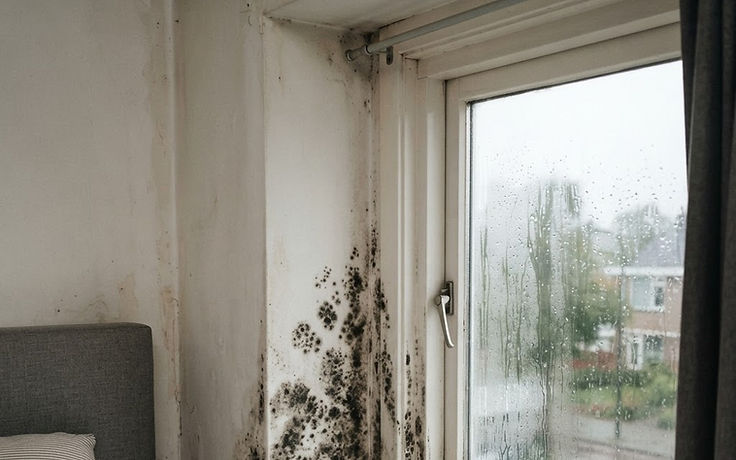
A Capitol Hill craftsman is a beautiful building. It is also, from a water damage standpoint, a sponge with excellent manners. Plaster on wood lath can absorb a remarkable amount of water before it ever shows a stain on the surface, and by the time a homeowner sees a faint ring on the ceiling, the leak has usually been running for months.
We work in Capitol Hill several times a month, and the pattern is remarkably consistent. Here is what makes this housing stock different, and how to catch a leak before it becomes a structural problem.
Why plaster hides water so well
Modern drywall is paper over gypsum. It fails fast and visibly: it softens, sags and stains. Plaster over wood lath is a different animal. The scratch coat and brown coat are porous and thick, so water spreads laterally through the plaster before it reaches the painted surface. The lath itself absorbs water, swells, and holds it against the studs.
The practical consequence: a leak that would show up on drywall in two days might take three weeks to appear on plaster — and by then the wood lath and the stud bay are wet, the insulation (if any) is saturated, and mold has a head start.
The five leak sources we find most often here
1. Original galvanised supply lines
Many 1900–1930 homes still have galvanised steel supply piping in service, usually at the risers and under bathroom floors. Galvanised pipe rusts from the inside out. It does not fail dramatically — it weeps at joints for months and then closes up with corrosion, which is why water pressure in these homes is often poor. Poor pressure is a symptom worth investigating.
2. Cast iron drain failures at the horizontal runs
Vertical cast iron stacks last remarkably well. Horizontal runs do not. A hairline crack in a second-floor drain line drips directly onto the ceiling below, and because drains only carry water intermittently, the leak is tiny and constant. The result is a slowly spreading stain and a soft spot in the plaster.
3. Roof and dormer penetrations
Craftsman rooflines are complicated, with dormers, valleys and shallow pitches that shed water slowly in a Pacific Northwest drizzle. The failure mode is usually at a valley or step flashing, and it leaks for years without visible interior evidence until the sheathing softens.
4. Window head and sill intrusion on wind-driven rain days
Original double-hung windows are charming and not weather-tight. On the days when rain comes in sideways for eight hours, water gets past the head casing, into the wall cavity, and sits on the sill plate. This is the single most common cause of wet-wall calls in January and February.
5. Basement and foundation seepage
Capitol Hill's slopes push groundwater toward foundations that were never waterproofed. An old stone or brick foundation wicks water upward by capillary action and shows it as white powdery efflorescence — a reliable sign the wall is damp.
How we find water in a plaster house
You cannot find a leak in plaster with your eyes, so we do not rely on them.
- Thermal imaging — evaporating water cools a surface. The camera shows the cold anomaly through the plaster without opening anything.
- Pin-type moisture meters at highest-gain setting, swept in a grid along baseboards, ceilings and window walls.
- Non-invasive moisture meters for tile and behind cabinetry, where pins cannot go.
- Relative humidity mapping of rooms that share a wall with the suspected leak.
On a recent job two blocks off 15th Ave, a homeowner had a one-foot water stain on a dining room ceiling. Thermal imaging showed a wet field eleven feet long, running from a second-floor bathroom drain four rooms away. The stain was simply where the water finally found a hole in the lath.
Does plaster have to come out?
Less often than you would expect, and more often than a drywall-era contractor will tell you. Plaster that is intact and only damp can usually be dried in place with cavity drying systems — we inject warm dry air behind the surface and pull it out through a sealed exhaust. Plaster that has gone soft, crumbled, or grown mold must come out, and we will tell you honestly which category you are in after the first visit.
When it does come out, we match the texture and profile. A proper plaster repair is not drywall with a heavy texture coat; it is a base coat and finish coat matched to the surrounding wall so that the repair disappears under raking light.
What to do tonight if you suspect a leak
- 1Write down the date you first noticed the mark, and photograph it with a straight edge or a coin for scale.
- 2Check your water meter with every fixture off. If it moves, you have a live supply leak.
- 3Feel the wall. Cool and slightly soft means wet; warm and hard means dry.
- 4Do not paint over it. Paint traps moisture and guarantees the plaster fails later.
- 5Call 425 390 5911. A diagnostic visit costs nothing and takes under an hour.
The plumbing swap every Craftsman eventually needs
The original galvanised supply lines in a Capitol Hill house are 90 to 110 years old. Galvanised steel rusts from the inside, so the pipe you can see is not the pipe you have: a one-inch line can be reduced to a half-inch bore by scale, which is why the shower loses pressure when the kitchen tap runs. The failure that floods a wall is a pinhole that opens without warning where the pipe was clamped to a stud.
A partial repipe is a trap. Replacing the visible run in the basement while leaving the vertical stacks and the runs behind the plaster means the next failure is in the part nobody replaced. When we find three or more pinholes in different locations within a few years, we tell the homeowner to plan a whole-house repipe rather than repair a fourth.
Does insurance pay for a repipe?
No. A repipe is maintenance, and policies exclude it. What is covered is the sudden damage from the failure, and some carriers will cover the access opening and closing of the wall needed to reach a failed joint. If you are already opening walls for water damage, price the repipe at the same time: the expensive part is the access, not the pipe.
What do I do tonight if a pipe is seeping in a wall?
Shut the main off, photograph the wet area, and leave the wall closed until someone can read it. Water in a plaster wall can travel horizontally several feet along the lath, so the wet patch you can see is not the extent of it. Then get a plumber for the pipe and a restoration crew for the cavity, on the same day if you can.
Capitol Hill is one of our favorite neighborhoods to work in precisely because the buildings are worth saving. They just need someone who understands how they were built. If you want to read about the other classic Seattle problem, our piece on mold in Queen Anne hillside homes covers the moisture side of the same story.
- Water damage
- Capitol Hill
- Historic homes
- Seattle

