
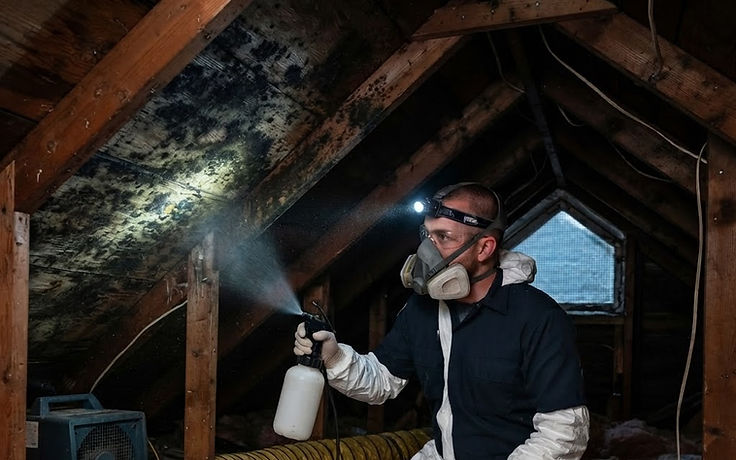
If you shine a light into the attic of a 1920s bungalow anywhere from Ballard to Beacon Hill, there is a decent chance the underside of the roof deck is speckled with black. Homeowners find it during a storage run in November, panic, and call us expecting to hear that the roof is ruined. Usually the roof is fine. The humidity below it is not.
Mold on roof sheathing is a symptom. The cause is warm, moist air from the living space finding its way into a cold attic and condensing on the coldest surface available, which is the underside of the deck.
Why this housing stock is so prone to it
- Bath fans that vent into the attic. We find this constantly on mid-century remodels. The fan is ducted, but the duct stops at the insulation line and dumps a bathroom of humidity straight into the cold space.
- Missing or collapsed air sealing. Recessed lights, top plates, plumbing chases and chimney chases all leak warm air upward by stack effect.
- Soffit vents painted over or buried in insulation. Without intake air, an attic cannot flush moisture no matter how many roof vents exist.
- A cold snap after a wet autumn. Seattle attics carry a lot of latent moisture into December. The first hard freeze turns it into condensation on the deck.
What remediation actually requires
Do not let anyone spray the rafters with bleach and leave. Cleaning without fixing the moisture path guarantees a return visit next winter. Our sequence is: containment and negative pressure with a HEPA air scrubber, HEPA vacuuming of the affected sheathing and framing, antimicrobial treatment of the deck, then, critically, an air sealing and ventilation correction so the humidity never comes back.
When the deck actually is damaged
Structural concern starts when the sheathing is soft, delaminated, or visibly stained through from above. That points to a roof leak that has been running a long time, not just condensation, and it needs a roofing contractor in the scope. We will tell you plainly which one you have after a thermal scan and a moisture reading on the deck.
The stack effect, in plain terms
Warm air leaves a house from the top and replacement air enters at the bottom. In a 1920s bungalow that means the attic is the exhaust and the crawlspace is the intake. Every cubic foot of moist air rising from a bathroom fan, a dryer, a damp basement or a pot of pasta passes through the attic on its way out, and the roof sheathing is the last cold surface it touches before it leaves.
Sheathing in a vented Seattle attic sits within a few degrees of outdoor air from October through April. When air at 45% relative humidity at 68 degrees meets a deck at 40 degrees, it condenses. Repeat that every evening for a winter and the north-facing deck is damp for months at a stretch. Mold needs four days of that. It gets a hundred and fifty.
What a real attic scope includes
- Air sealing first. Recessed cans, top plates, chimney chases and bath fan housings get sealed with foam and caulk. Without this, remediation is a cleaning you will repeat next winter.
- Bath and dryer fans ducted to the exterior. A fan that terminates in the attic is a mold machine running every time someone showers.
- HEPA vacuum and wire brushing of the affected decking, rafters and trusses, followed by an antimicrobial application that meets IICRC S520 for the condition found.
- Baffles kept clear so the soffit vents still breathe after insulation work.
- Verification. A post-remediation moisture reading and, when the area is large, third-party clearance with air sampling.
Does a powered attic fan fix it?
Usually not, and often it makes things worse. A fan big enough to change the deck temperature pulls conditioned air out of the living space through every gap in the ceiling, which raises the moisture load it is trying to remove. Mechanical ventilation only works alongside air sealing, never instead of it.
Can I just spray it with bleach?
Bleach kills the surface and leaves the food source: dust, cellulose and the damp that grew the colony. It also wets framing that was starting to dry. The reason a remediation is documented rather than scrubbed is that the fix has to hold through the next rainy season, and that requires the moisture path to be closed, not the stain to be painted over.
What an attic remediation costs, line by line
A 600 square foot attic with surface growth on the decking typically lands between 3,500 and 7,000 dollars. Containment and negative air with a HEPA scrubber is the first line, then the labour to HEPA-vac and wire brush every rafter bay, then the antimicrobial application, then the drying if the deck was wet enough to need it. Air sealing and vent correction are usually a separate scope, and they are the part that keeps the number from coming back.
What pushes a job to the top of that range is access. An attic with no pull-down stair, a 4-foot ridge height and blown insulation everywhere takes twice as long to work in, and the containment has to be built to protect the living space from the access path as well as from the attic itself. On a Seattle bungalow with a finished second floor, that access question is often the largest single variable in the estimate.
One more cost most homeowners do not expect: replacing the insulation. Blown cellulose that has taken water is removed with the contaminated debris, and it does not go back. That is a real line item, it is usually covered as part of the loss, and it is worth knowing before you compare two quotes that only one of them includes.
If you have found black growth in Seattle, call 425 390 5911. A diagnostic visit is free, and it is a great deal cheaper than replacing a roof deck.
- Mold
- Attic
- Seattle
- Ventilation

