
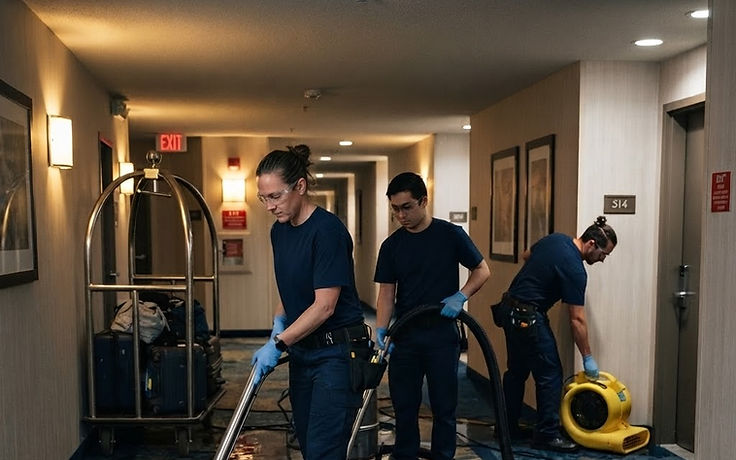
A hotel water loss has two problems running at once: the water, and the occupancy. A single failed toilet supply line on the third floor of a Tacoma property can wet six rooms, a corridor, and the lobby ceiling below, and every room out of service is revenue the property will never recover.
Stage the work, do not tent the floor
The instinct is to shut a whole wing and dry it in one pass. That is the most expensive possible plan. We stage in zones: the source room and the two rooms adjacent get contained and dried first while the corridor stays open with air movers and a temporary moisture barrier, then the work moves down the line.
- Guest safety first. Any room with water in a light fixture or at a receptacle is locked out until an electrician clears it.
- Soft goods triage. Mattresses and box springs wick fast. Photograph and remove same hour; a saturated mattress is a total loss and a health code issue.
- Corridor carpet. Extract, then float with air movers and dry using a desiccant unit to keep humidity down while guests walk past.
- Odour control. A damp hotel corridor smells like a damp hotel corridor. Hydroxyl generators run overnight in unoccupied zones.
Coordination is the job
We work with the front desk on a room-release schedule, with housekeeping on linen and soft-goods inventory, and with the carrier on documentation. Daily drying logs go to the general manager each morning so occupancy decisions are made with numbers instead of guesses.
Why one supply line can take twelve rooms
A hotel corridor is a plenum full of shared services. Water leaving a failed angle stop in room 412 travels along the carpet into the corridor, then wicks into the demising walls of the four rooms on each side, and, if the floor assembly is a post-tension slab with a topping pour, migrates under the topping into rooms that never saw a drop. By the time the guest in 414 reports a damp carpet, the wet footprint is usually six to ten times the room it started in.
That geometry is why hotels are dried in stages rather than all at once. The property cannot take a whole wing out of inventory, so the work is sequenced around which rooms can be returned to sell tonight, which are blocked for two days, and which need the wall opened.
The staging logic we run on a hotel corridor
- Stage one: stop the water, extract the corridor, and set high-velocity air movers with the corridor doors wedged open to use the hall as a drying chamber.
- Stage two: treat guest rooms in pairs, alternating so that adjacent inventory stays sellable.
- Stage three: open drywall at the base of the worst walls only, cut to the flood line, and dry the stud bays.
- Stage four: rebuild in the same pairs, so the property is never holding more than two rooms of reconstruction at a time.
Can guests stay in rooms next to the drying equipment?
Usually not directly adjacent, because the noise and the humidity read as an unfinished room to a paying guest. Two doors down is workable if the corridor is kept pressurized and the equipment runs through the night on a schedule the front desk can explain at check-in.
Who handles the guest relocation?
That stays with the property, but we give the front desk a room-by-room status sheet each morning with an expected return date. Handing guests a specific date is what prevents the comps and the reviews that cost more than the dry-down.
The inventory math the front desk needs
A hotel loss has a revenue line that the building repair does not: rooms that cannot be sold. On a 120-room property at 80 percent occupancy, taking eight rooms out for three nights is roughly 23 room-nights, and at an average rate of 190 dollars that is about 4,400 dollars in room revenue, before the comps and the relocations. Those numbers belong in the claim, and they belong in the decision about how fast to dry.
That is why the drying plan starts with which rooms can be returned to inventory and when. A crew that tells the front desk "about a week" forces the property to block seven nights conservatively. A crew that gives a room-by-room date lets the front desk sell the rooms behind the equipment, and the property usually recovers a third to a half of the lost inventory over the same period.
The documentation matters here as much as in a house. A daily status sheet, timestamped photos per room, and a moisture log that matches the rooms off the market is what an adjuster needs to accept the business interruption number rather than argue it down.
For hospitality losses in Tacoma and across Pierce County, call 425 390 5911. We can be on site before the night audit finishes.
- Commercial
- Hotel
- Tacoma
- Hospitality

