
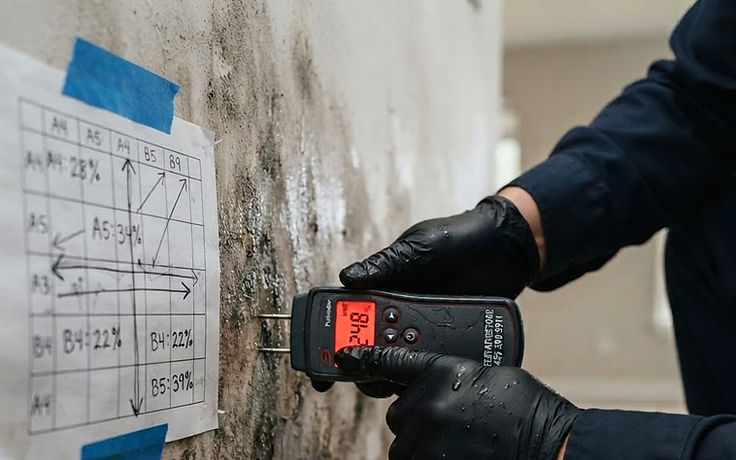
A moisture reading is only meaningful next to a reference reading from the same material in a dry part of the same house. "Your wall reads 18%" means nothing. "Your wall reads 18% and the matching wall in the hallway reads 8%" is a claim line item.
The three numbers we record
- 1Moisture content of the affected material, as a percentage, from a pin meter at a consistent height and depth.
- 2A reference reading in an unaffected room of the same construction, which sets the dry standard for this house.
- 3Ambient conditions of temperature and relative humidity, because drying performance is a function of the air, not just the wall.
Rough thresholds worth knowing
- Wood framing above roughly 20% moisture content is at risk of decay fungi.
- Drywall paper above about 1% on a non-invasive meter, or 12 to 15% on pins, is wet enough to support mold.
- A floor that reads within 2 points of a known-dry floor of the same species is generally considered dry.
What the percentage on your report means
A pin meter reads electrical resistance between two probes and converts it into a moisture content percentage calibrated for wood. On drywall, plaster or concrete the same number is indicative rather than absolute, because the material is not wood. That is why a report should compare a wet reading to a dry reference taken in the same material in the same room, and why a bare percentage with no reference is close to meaningless.
For wood, the numbers are well established. Below 15% is dry for framing in service. Between 16% and 20% is elevated. Above 20% supports wood-decay fungus, and above 28% is actively decaying. A rafter that reads 30% is not damp, it is failing.
Reading a drying log the way a claim reviewer does
- Baseline day: where the water went, in a room-by-room map, with photos of each reading.
- Reference points: at least one dry reading per material per room. Without it, nothing can be judged.
- Trend: a drying log that does not fall by a few points per day means the setup is wrong, not that the house is unusual.
- Completion: materials within 2 to 4 points of the dry reference, in the same room and material, on the same day.
- Gaps: a reading taken on a painted surface, or through a baseboard, is not a reading of the assembly.
Why do you use two different meters?
A pin meter gives a numeric reading in a specific spot. A pinless meter scans a surface and finds patterns. On a loss we scan to find the shape of the wet area, then pin to measure specific points, then confirm with thermal imaging where the surface is not accessible. Three tools, three answers, one map.
What if the number goes up?
Either the source is still running, the equipment is not reaching the area, or the room is open to humid outside air. Those are the only three explanations, and finding which one is the job. A reading that climbs two days in a row means the drying strategy changes rather than waits.
The three numbers that matter at the end of a job
A dry-down is finished when three things agree. The material reading is within a couple of points of its dry reference, taken in the same material and the same room. The relative humidity in the affected space is in the same range as an unaffected area. And the visual condition is what a meter cannot show: no swelling, no staining that indicates ongoing water, no soft spots.
That is the package we hand over, with the daily log behind it. It is also what justifies the rebuild: a contractor who closes a wall over a wet assembly is taking a risk that becomes visible months later, and the signed readings are how that risk gets allocated correctly.
For a homeowner, the useful thing to remember is simpler than the numbers. Ask to see the log, ask what the dry reference was, and ask for the final page in writing. A company that answers those three questions is a company that will also answer them to your adjuster.
Why two technicians can get different numbers
Meter readings depend on contact pressure, probe depth, the material and the meter’s calibration. Two people measuring the same wall can differ by several points if one presses hard and the other rests the pins. That is not a scandal, it is why the industry compares readings taken by the same person, in the same spot, on the same day, against a reference.
So when a report shows a wall dropping from 24 to 15 over four days, the trend is the evidence, not the absolute figure. And when a homeowner’s own meter reads differently from ours, both can be true. What matters is the reference and the direction of travel.
Documented drying in Tacoma and Pierce County: 425 390 5911.
- Water damage
- Documentation
- Tacoma
- Education

