
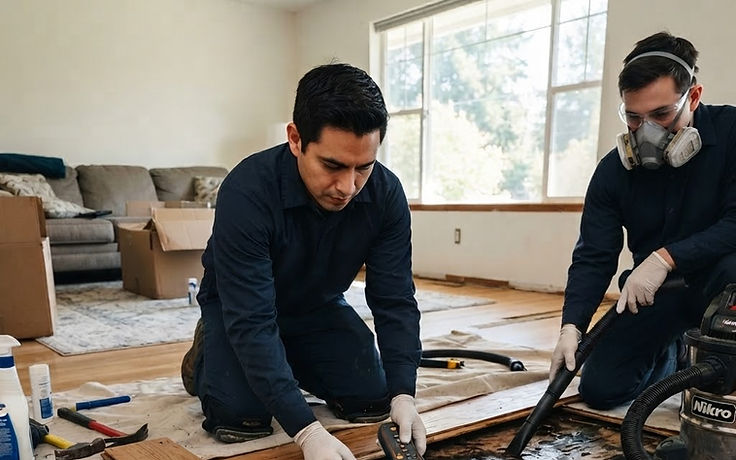
A hardwood floor is a sandwich: finish, wood, underlayment, subfloor, framing. Water that gets into the middle of that sandwich has nowhere to evaporate, and the underside of the wood is a perfect food source. The finished surface can look perfect while the cavity below is alive.
The tells
- A musty smell that is strongest at floor level and in one room.
- A hollow or "soft" sound when you tap a specific area of the floor.
- Cupped seams near a sink, dishwasher or exterior door.
- An old water stain on a ceiling below the same location.
Finding out without demolishing the room
We lift a single board at a seam near the suspect area — usually one board, in a closet edge if possible — and read the cavity. That tells us whether the subfloor is wet and whether the growth is localized or a broad field. From there we can plan a patch repair instead of a whole-room replacement.
Saving the floor
If the wood is structurally sound, drying mats can pull moisture out from above while air movement handles the cavity from below. If the subfloor has growth, it gets treated or replaced, and the wood is dried and reinstalled. Finish matching is the last step, and it is where a careful restoration shows: a patch that is sanded and blended into the surrounding finish is nearly invisible.
The tells that a floor is growing something underneath
Hardwood over a wet subfloor has no way to dry. Water goes down through the seams and stops at the subfloor, and the finish on top seals the moisture in. The floor itself can feel perfectly solid, because the damage is to the subfloor and the underside of the boards rather than to the wear surface. What you notice instead is a smell that is strongest near the floor, and a darker greyish tinge in the seams.
The other tell is a subtle lift. Boards cup slightly, so a straightedge laid across the floor will rock a millimetre or two. If the cupping is uniform across a room, it is probably a humidity swing. If it is localized near a dishwasher, a bathroom door or an exterior wall, it is coming from underneath.
Finding out without demolishing the room
- Pin meter readings on the wood surface, then thermal imaging to see the cold, damp pattern under it.
- A reading at a floor register or a return grille, which reaches the cavity under the floor.
- Inspection from below if there is a basement or crawlspace: the subfloor underside tells the truth.
- A test pull of two or three boards in the least visible spot to confirm what the meter suggests.
How much of the floor has to come up?
Only the wet zone, plus a margin, and it is defined by the meter rather than by the room. In a Kirkland kitchen we often pull a four foot by six foot section, dry the subfloor, treat it, and relay the same boards. The homeowner sees a repair, not a new floor.
Can a mat system save the floor in place?
Yes when the water came from above and the subfloor is accessible from below, or when the floor can be sealed and put under suction. Drying mats pull water up through the wood with negative pressure while dry air circulates. It works best in the first 48 hours, and it does not work at all if the water is still running.
What saving a floor actually costs against replacing it
A drying mat job on 400 square feet of installed hardwood typically runs 600 to 1,500 dollars in equipment and labour, plus the subfloor repair if it was needed. Removing and replacing the same floor with a comparable product is 5,000 to 12,000 dollars depending on the species, the finish and whether the boards have to be milled to match an existing floor. The gap is why the first 48 hours are worth a phone call at midnight.
With engineered flooring the maths changes, because a saturated core can delaminate and no amount of drying reverses it. With solid oak or maple, the boards usually survive and can be relaid after the subfloor is fixed. That distinction is the first question we ask: what is the floor made of, and how long was it wet.
What the subfloor looks like when the boards come up
Under a floor that has been growing something, the subfloor is usually the story: dark staining across a defined area, a soft edge where the panel met a joist, and often a line where the water stopped spreading. That line is how the repair extent gets set, and it is why we read the subfloor rather than the room.
A panel that has delaminated comes out and gets replaced. A panel that is stained but structurally sound can be dried, treated and sealed, and it does not have to be replaced to be safe. Photos of both, before treatment and after, are what an adjuster needs to accept the smaller repair.
Floor and subfloor assessments in Kirkland: 425 390 5911.
- Mold
- Hardwood
- Kirkland
- Floors

