
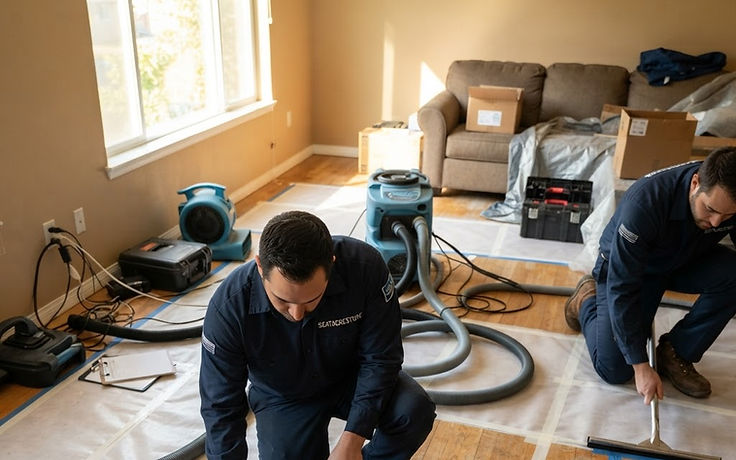
An installed hardwood floor is a sealed assembly. Water that gets under it cannot evaporate from below and will not evaporate through the finish. That is why so many floors get torn out unnecessarily. Drying mats exist to solve exactly this.
How the system works
A mat is sealed to the floor with the edges taped down, and a vacuum pulls negative pressure through the seams. The pressure drop at the surface encourages moisture in the wood to move to the air, and the water leaves as vapour instead of having to be pulled through the subfloor. Combined with below-floor air movement, it dries a floor far faster than air alone.
When it is worth doing
- Clean water, within roughly 24 hours of the loss.
- The floor is cupped but not delaminated, and the finish has not lifted.
- The subfloor beneath can be dried or is structurally sound.
- The readings can be taken repeatedly so progress is measurable.
How a mat pulls water out of a floor
A drying mat is a sealed panel with a hose port, laid over the wood and taped down at the edges. A vacuum pulls the mat tight to the floor, and the negative pressure under it lowers the vapour pressure at the wood surface. Water moves from the wet boards into the dry air being drawn across them, and out through the hose to a dehumidifier.
The key is that nothing has to be removed. On a glued-down or nail-down floor over a slab or a sealed subfloor, a mat system is the only way to dry the assembly without tearing it out, and it works on engineered and solid products alike with different cycle times.
When mats work, and when they do not
- Work well: within 24 to 48 hours of the water event, on a floor with a sealed finish, over a subfloor that can dry from below or is not itself saturated.
- Work partially: on a floor that has cupped, where the panels dry the boards but the cupping may not fully flatten.
- Do not work: when the subfloor is saturated and has no drying path, when the water was category 3, or when the floor has been wet long enough to delaminate.
Will the floor look the same afterwards?
Usually yes, with a caveat: a floor that took water can show a slight texture change where boards cupped and flattened, and a finish that was worn can look different in the dried area. We test a small area first and photograph the result so the expectation is set before the whole room is committed.
What if the mat does not work?
Then the affected boards come up and the subfloor gets dried directly. The boards are often salvageable and reusable, because oak and maple are stable once dry. What does not survive is usually the subfloor panel, and that is a far smaller repair.
What the reading has to show before the mats come off
Every matted area has a dry reference: a section of the same floor in the same room that was never wet. The mats come off when the matted reading is within a couple of points of that reference, not when the surface feels dry or the colour has evened out. That usually takes three to six days on a solid floor with a moderate wetting, and longer on engineered product with a fibre core.
The check is repeated after the mats come off, because a floor that reads dry under vacuum can climb for a day once the pressure is released. That second reading is the one that counts, and it is the one a hurry will skip.
What a mat will not fix
Mats do not remove staining, they do not flatten a board that has cupped past its elastic limit, and they do not fix a floor that took contaminated water. They also cannot dry a floor where the subfloor has no drying path, because the water has to go somewhere and a mat only pulls from the top. In those cases the honest answer is removal, and it is usually cheaper than a week of equipment on a floor that will be replaced anyway.
What the mat buys is the middle case, which is most cases: a good floor, wet from above, caught early, with a subfloor that can breathe. That is a floor worth saving, and it is the reason a mat system stays on our trucks.
Floor drying assessments in Issaquah: 425 390 5911.
- Water damage
- Hardwood
- Issaquah
- Drying

