
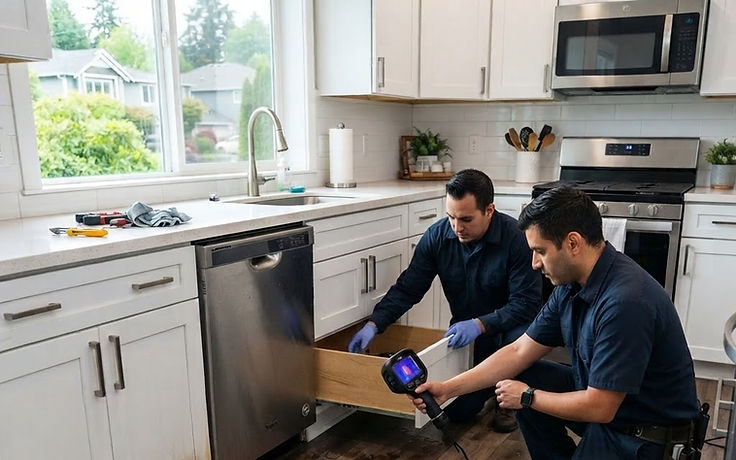
Dishwashers leak in places you cannot see: the door gasket drips onto the floor edge, a supply fitting weeps behind the unit, and the drain hose connection at the disposal loosens. None of these produce a puddle you would notice. They produce a damp toe kick, a swollen cabinet floor, and eventually a soft spot in the vinyl.
Signs worth acting on
- Delamination at the bottom edge of the cabinets beside the dishwasher.
- A musty smell that appears only around the sink run.
- Vinyl flooring lifting at a seam or a dark stain under the mat.
- Water staining on the basement ceiling directly below the kitchen.
How we scope it
We pull the unit and use a thermal camera on the cabinet base and the subfloor, then pin meter the material behind the toe kick. If the cabinet box has swollen past a few millimetres, it does not come back; particleboard and MDF lose their structure permanently once saturated. The good news is that a cabinet run can usually be repaired rather than replaced, and matching a door profile is easier than most homeowners expect.
The slow leak under the counter
A dishwasher supply line leaks at the elbow, a door gasket weeps during the wash cycle, or the drain hose fitting loosens at the disposal. None of these produce a flood. They produce a cup of water per cycle that lands on the subfloor and spreads under the cabinet toe kick, where it stays because there is no airflow and no way to evaporate. That is months of damp.
The damage pattern is consistent: soft toe kick, swollen particleboard cabinet sides, a delaminated subfloor edge, and mold on the back panel of the cabinet next to the dishwasher. In a Shoreline kitchen with original 1960s cabinets, the run under the sink is often the first thing to fail.
Signs worth acting on
- The toe kick or cabinet floor darkens or feels soft when pressed.
- A vinegar or mildew smell inside the cabinet under the sink after the dishwasher runs.
- Vinyl flooring lifting or cupping within three feet of the machine.
- Water stains on the ceiling of the room below the kitchen, which means the subfloor is saturated.
- A dishwasher that leaves standing water in the bottom, meaning the drain path is restricted.
How do you dry under a cabinet?
The toe kick comes off, or a drying port is drilled at the base of the cabinet, and dry air is injected into the cavity while a dehumidifier pulls the moisture out of the room. Water-damaged cabinet panels that are structurally sound can sometimes be saved this way. Particleboard that has swelled cannot be un-swollen, and it gets replaced.
Do I need to pull the dishwasher?
Yes, at least once, so the floor under it can be read and dried. Leaving a machine sitting on a wet subfloor seals in the moisture and lets the cabinet sides take it instead. Pulling it takes ten minutes and usually saves the cabinet run.
What a cabinet repair actually involves
The visible repair is a new toe kick and maybe a section of cabinet floor. The work behind it is the reason the job is worth doing properly: the subfloor edge has to be dried and, if it has delaminated, cut back to solid material and patched. The cabinet sides are read to see how far the swelling reaches. The wall behind the machine is checked, because water that runs under a dishwasher often runs to the wall and up.
Then the machine goes back, and two things get replaced while it is out: the supply line, with a braided stainless hose, and the drain hose connection at the disposal or the standpipe. Putting a fifteen-year-old hose back on a freshly repaired cabinet is how the same call happens again in two years.
Appliance leak response in Shoreline and north King County: 425 390 5911.
- Water damage
- Appliances
- Shoreline
- Kitchens

