
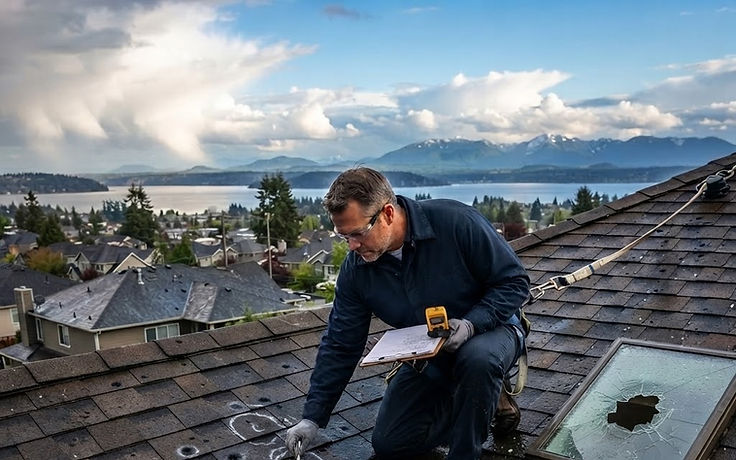
Hail in the Puget Sound lowlands is usually small and brief, which is exactly why it gets ignored. The damage that matters is not the shingle you can see from the ladder. It is the bruised mat under a granule loss, and the soft spot that becomes a leak two winters later.
Real hail damage versus normal wear
- Impact marks are round, soft to the touch, and often have a granule-free centre. They appear in a pattern across slopes that faced the storm.
- Wear is uniform loss of granules along the bottom edge of a shingle, usually on the sunny south slope.
- Bruising is visible from the underside as a fracture in the mat, and a good inspector checks the deck from the attic too.
- Soft metal is the giveaway: dented vents, flashing and gutter guards confirm hail reached the roof.
Why the inspection matters to your claim
Carriers pay for hail damage and not for aged shingles, so the file has to separate them clearly. A photograph of a dented vent beside an impact-marked shingle, with a chalk circle and a date, is the kind of evidence that turns a disputed claim into an approved one.
Real hail damage versus normal wear
Hail impact on an asphalt shingle leaves a soft spot where the mat has been fractured, usually with a dark bruise in the centre and granules knocked away in a ring around it. You find them by running a hand over the slope, not by looking, because the fracture is under the surface. They cluster: on one slope, at one height, in the field of the shingle rather than at the edges of the shingle tab.
Granule loss from age looks different. It is diffuse, heavier near the valleys and the ridge where traffic occurred, and it comes with curl, blister or exposed mat. A roof that is 18 years old in Everett will show plenty of that. An inspector who photographs every worn spot as hail damage is writing a claim that gets denied, and the homeowner is left with no repair and a ding on the roof record.
What a defensible inspection includes
- Chalk circles on every test square with a scale or a coin for reference in each photo.
- A soft-metal test on gutters, downspouts, vents and flashing, which is the most reliable hail indicator on a roof.
- Slope by slope records, so the pattern can be read as directional, as hail actually falls.
- A dated field sheet noting weather, orientation and roof age, plus a granule-loss estimate.
- Separation of impact damage from wear in the report, which is the item that decides the claim.
Should I file the claim before or after the inspection?
Have the inspection first. Filing without evidence means an adjuster visits an undamaged roof and closes the claim, and a closed claim is much harder to reopen than a new one. With the inspection in hand, the claim opens with a reason attached.
Do you repair roofs?
We do the water damage and the interior, and we work alongside licensed roofers for the exterior repair. What we bring to the inspection is the documentation standard, plus the interior evidence when the hail has already punched through a vent or a skylight seal.
What the claim timeline looks like after a hail event
Hail claims move slowly because they are usually filed in volume. After a storm track crosses Snohomish County, every roofer in the region is on every roof in the same week and carriers are processing hundreds of inspections. Filing with a completed inspection report in hand puts a claim ahead of the ones filed on a description, because the adjuster does not have to schedule a second visit to establish whether there is damage.
The typical timeline is two to six weeks from filing to a decision on the roof, and the interior work, if any, can usually run in parallel once the leak path is protected. Where it goes wrong is when the roof is repaired before the carrier inspects it. A repaired roof has no evidence on it, and that claim is over.
The other local wrinkle: hail here often arrives with wind, and a claim that mixes wind damage and hail damage on the same slope needs both documented or the carrier will attribute the wear to whichever is easier to exclude. Slope-by-slope notes solve that before it becomes an argument.
Roof and storm inspections in Everett: 425 390 5911.
- Storm damage
- Hail
- Roof
- Insurance claims

