
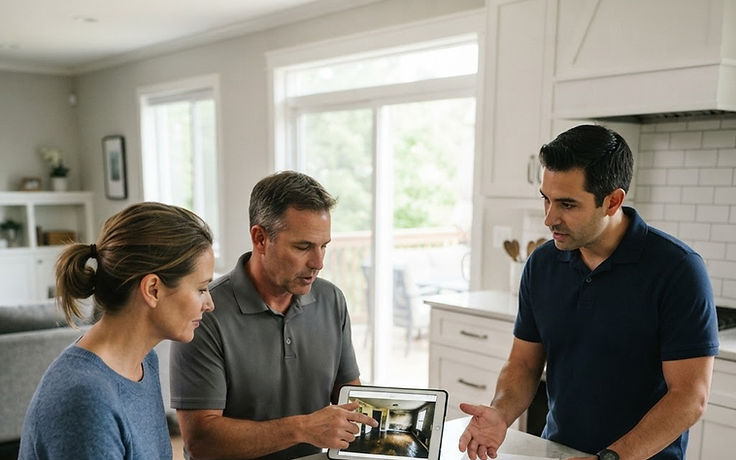
99.9% of the insurance claims SeaTacRestore documents are approved. That is not because we are lucky or because we have a special relationship with carriers. It is because we write the file the way adjusters are trained to read it, and because we start on the day of the loss instead of the day after.
This is the playbook, written for homeowners in King County and across the Puget Sound who have never filed a property claim before.
The four words that get claims denied
"It has been leaking for a while"
Washington policies cover sudden and accidental water damage. They exclude "constant or repeated seepage or leakage over a period of weeks, months or years." Say that sentence to an adjuster and you have just handed them their denial. If a leak has genuinely been ongoing, describe what you observed and when — do not narrate a conclusion about duration.
"I noticed it last month but didn't get around to it"
Most policies require prompt notice and reasonable steps to mitigate. A month of inaction is enough grounds for a partial denial or a reduction for the damage that could have been prevented. Report the same day. Every time.
"I think it's been wet since we moved in"
Policies exclude long-term deterioration, rot and "wear and tear." If a component failed because it was 40 years old, the resulting damage is often still covered — but the failed component itself is usually not. Write the distinction down clearly: failure event vs. long-term condition.
"I already threw the wet stuff away"
This is the most common self-inflicted wound in the entire process. Saturated carpet, a ruined sofa, a warped cabinet door — those are the evidence of the loss. Photograph before disposal. If it must go to prevent mold, photograph it in place, note the dimensions, and keep a small sample where practical.
What an adjuster actually evaluates
A property claim file is read once, quickly, by someone with 200 of them. They look for specific things:
- A clear cause of loss with a date and mechanism — "supply line to the upstairs toilet failed on 14 October" beats "water damage to bathroom."
- Photographic evidence of the cause, not just the damage. A photo of the failed fitting is worth ten photos of the wet carpet.
- Moisture readings that show affected vs. unaffected materials, so the affected area is a measured number, not a guess.
- Drying logs dated daily, demonstrating that mitigation happened continuously. This is also what justifies equipment rental days.
- An itemised scope in a line-item format the industry uses — Xactimate is the standard.
- A photo inventory of contents, room by room.
Notice that every item on that list is documentation, not construction. That is the whole game.
Deductible, out of pocket, and the phrase "zero"
Your deductible is what you pay before the carrier pays anything. It is a fixed contract number, typically $1,000 to $5,000 on a Washington homeowners policy.
Where we can help with the out-of-pocket side: on qualifying full-service jobs we credit your deductible back against our own scope. So the practical result for most clients is zero out of pocket beyond the deductible, and frequently zero altogether. Read any offer carefully — a "we cover your deductible" claim that only applies to a padded invoice is not help, it is accounting.
The nine-day claim timeline
- 1Day 0 — Loss occurs. Water shut off, photos taken, call placed.
- 2Day 0, hour 1 — Crew on site, mitigation begins, cause photographed and documented.
- 3Day 1 — Claim opened with cause of loss and first-day moisture map. Adjuster assigned.
- 4Day 2–3 — Full scope written. Mitigation continues with daily logs.
- 5Day 4–6 — Adjuster site visit. We meet them. Scope reconciled line by line.
- 6Day 7–9 — Approval, then rebuild scheduling or final drying verification.
- 7Week 2+ — Reconstruction. Your project manager owns the schedule from here.
Nine days to approval is our median. The outliers are almost always claims where the homeowner waited a week to report, or where the cause was genuinely ambiguous.
Do you need a public adjuster?
Only in specific situations: a very large loss, a disputed cause, a carrier that has issued a partial denial you believe is wrong, or a commercial loss with business interruption. A public adjuster typically charges 10–15% of the settlement, which is real money. For a normal residential water loss with clean documentation, you do not need one — and a restoration company that documents properly is doing most of that work anyway.
Three questions to ask before you sign a work authorization
- 1Who meets my adjuster on site, and when?
- 2Will you bill my carrier directly, or will I be asked to pay and seek reimbursement?
- 3If the claim is denied, what am I obligated to pay?
Get those three answers in writing. A company that hesitates on the third one is telling you something.
What a supplement is, and why a first estimate is not a settlement
A first estimate is written before drying is complete, so it deliberately leaves the rebuild open. That is not an underpayment, it is a snapshot. As drying finishes, the readings define how much material has to come out, and a supplement is filed with those readings attached. Supplements are routine, expected, and how nearly every water claim reaches a fair number.
The mistake homeowners make is treating the first number on the page as a verdict, then arguing about it rather than supplying evidence. The evidence that wins a supplement is unemotional: moisture readings, thermal images, a room-by-room scope in the carrier’s own estimating language, and photographs of the demolition that was actually required.
How long does a supplement take?
Typically a week to three weeks, depending on the carrier and the size of the change. Drying and the initial scope proceed in the meantime, so a supplement is not a reason for work to stop. The exception is a disputed category of loss, which we raise before demolition rather than after.
Do I need a public adjuster?
For a straightforward supply line loss with a cooperative carrier, no. For a large loss with a coverage dispute, a denied category of loss, or a commercial claim with business interruption, a public adjuster can be worth their fee. It is a judgement call, and a restoration company that has walked a hundred claims can usually tell you which case you are in.
If you are looking at water right now, call 425 390 5911 before you read anything else on this website. If you want the emergency sequence, read the first hour of a Bellevue water loss next.
- Insurance claims
- Water damage
- Washington state
- Deductibles

