
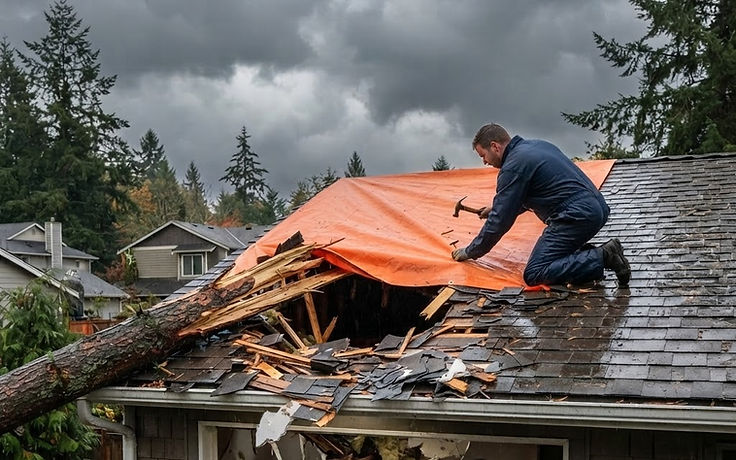
Douglas fir is a beautiful tree and a terrible roof load. When a limb or a whole top comes down, the damage is rarely just the hole. The impact racks the framing, breaks rafters, and pushes water into the ceiling assembly for as long as the sky keeps raining, which in November is a while.
The order of operations
- 1Get out from under it. If the ceiling is sagging or the ridge has moved, leave the room and call from outside.
- 2Do not cut the tree yourself. A limb under load can kick, and a chainsaw on a wet roof is a bad combination.
- 3Call your carrier and a restoration crew, in that order or the other; what matters is both get called today.
- 4Tarp the opening. Emergency tarping is a mitigation step, and carriers expect it. Photograph the damage before the tarp goes on.
- 5Protect the interior. Move contents out, cover what stays, and get standing water extracted.
What the inspection has to cover
A tree strike is a structural event, not just a roofing event. We check the rafters and ridge for cracking, look for racking at the wall intersections, and thermal scan the ceilings below to find water paths that do not follow the hole. Then the roof gets dried from underneath while the tarp keeps the weather out.
The order of operations after a tree strike
A tree through a roof creates an open hole in a house that is still occupied, in weather that is usually still raining sideways. Everything you do in the next 24 hours is about limiting how much of the house the water reaches. That means the hole gets covered before anything else, even though tarping feels less urgent than the water already on the floor.
The second priority is the tree itself. A certified arborist or emergency tree service removes the load from the structure under their own insurance. Removing a tree off a roof is not a homeowner job, and a limb under tension can release and take the rest of the roof with it.
Hour by hour
- 1Hour one: get everyone out of the rooms under the damage, shut off power to any circuit with water in it, and call dispatch.
- 2Hours two to four: emergency tarp and board-up over the opening, with the load transferred if the tree is still resting on the structure.
- 3Day one: extract standing water, set containment, and photograph everything before cleanup, inside and out.
- 4Day one to three: tree removal, then a structural assessment of rafters, ridge and ceiling framing.
- 5Week one: dry the assembly, then rebuild from the roof membrane down to the ceiling finish.
What has to be inspected, not just the roof?
Rafters and ridge for cracking, the ceiling framing where the impact was absorbed, the wall plate if the tree hit near the eave, and any mechanical in the path: attic ductwork, electrical, plumbing vents. Wind losses also strip shingles on the windward slope, so the inspection goes well beyond the hole.
Is it covered?
Falling objects, including trees, are typically covered on a homeowner policy, and most Washington policies do not exclude the removal of the tree that caused the damage up to a stated limit. The tree that falls without hitting anything is usually not covered for removal.
What the claim looks like when a tree is involved
A tree strike generates three separate categories of cost, and they are handled differently. The emergency work, tarping and board-up, is covered as mitigation. The structural repair and interior restoration is covered as damage. Tree removal is covered in most Washington policies up to a stated limit when the tree hit a covered structure, and is usually not covered when it fell in the yard without hitting anything.
Then there is the arborist question. Removing a 100-foot fir from a roof requires a crane or a climber, and the cost is real. Get the arborist’s invoice in the claim along with the photos, and make sure the removal is documented as necessary to the repair rather than as general tree work. That framing is what gets it approved.
Storm response across Snohomish and the county, 24 hours: 425 390 5911.
- Storm damage
- Wind
- Snohomish
- Emergency

