
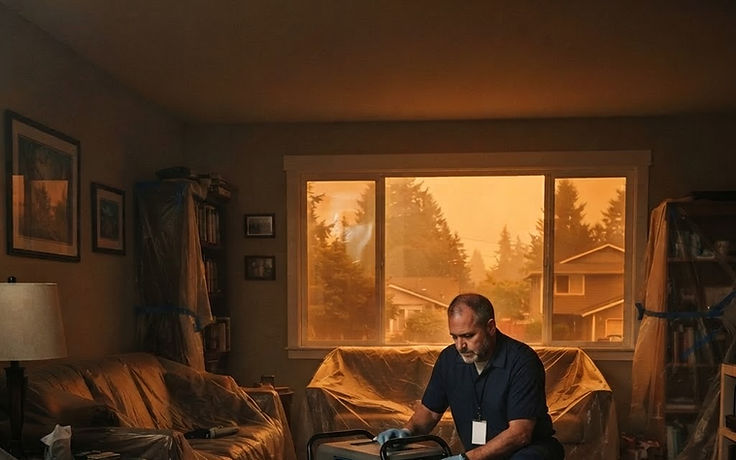
A week of wildfire smoke does to a house what a small fire does, at lower intensity. Fine particles and odour compounds settle into upholstery, carpet, curtains and the HVAC filter, and then every time the heat runs they volatilise again.
What does and does not work
- Air purifiers help particles, not odour. A HEPA unit removes the smoke that is airborne and leaves the smell in the sofa.
- Candles and sprays mask for hours. They add VOCs on top of the problem.
- Ozone is not for occupied homes. It is effective and it is also a respiratory irritant; hydroxyl generation is the safer route.
- Washing soft goods and wiping hard surfaces removes a surprising amount of the load before any equipment is needed.
The treatment that works
Clean the surfaces and the textiles, replace the HVAC filter, clean the coil and ducts if the system ran during the smoke event, then run hydroxyl generators in the whole volume for 24 to 72 hours. We verify by closing the house overnight and checking the air in the morning, because that is when a residual smell declares itself.
Why wildfire smoke behaves differently from a house fire
A house fire deposits soot on surfaces you can see. Wildfire smoke arrives as a gas and a cloud of very fine particles that enter through every open window, every bath fan and every gap around a door. It coats nothing visibly, which is why people assume the house is fine. The odour is in the soft materials: upholstery, carpet, clothing in closets, the cardboard of stored boxes, and the insulation in the attic if the house had a whole-house fan running.
That makes it a contents and air-path problem rather than a surface-cleaning problem. Wiping the walls of a smoke-affected house does almost nothing, because the walls are not where the smell lives.
What actually removes the odour
- Source removal. Wash or clean the soft goods: textiles go to an ozone or wet-cleaning process, not a fabric spray.
- Hydroxyl generation. Hydroxyl radicals oxidize odour molecules in the air and in materials, and unlike ozone they are safe to run in an occupied home.
- Air scrubbing. HEPA plus carbon filtration captures the fine particulate and the odour compounds it carries.
- A sealed envelope. Close windows, run the HVAC fan with a new filter, and let the equipment work instead of airing the house out.
- Time. Hydroxyl treatment on a whole house runs three to five days. There is no three-hour version that holds.
My house does not smell inside, but the closets do. Why?
Closets, crawlspaces and attics exchange air slowly, so they hold the smoke longer than an open room. They also hold the materials that absorb it: clothing, bedding, paper and cardboard. The fix is to treat the whole envelope, not just the living space, and to wash the textiles rather than spraying them.
Will my insurance cover smoke from a fire 40 miles away?
Sometimes, under the smoke and ash provisions of a homeowner policy, and it depends on whether there was a visible deposit or documented air quality impact at the property. Documentation of the interior air quality and the affected materials is what supports the claim.
What the treatment costs, and how it is scheduled
Whole-house hydroxyl treatment on a typical Puget Sound home runs 2,500 to 6,000 dollars depending on square footage, the number of machines required and how many days it takes. The machines are sized to cubic footage and left in place for three to five days, with a technician visiting daily to confirm the output and to rotate machine positions so no room is under-treated.
The schedule matters because hydroxyl treatment runs in an occupied house. Windows stay shut, the equipment runs quietly in living areas, and the family keeps living there. Laundry, textiles and soft goods get washed during the same period, because the treatment cannot reach the inside of a folded blanket any more than a spray can.
When the smoke is bad enough to leave
There is an air quality threshold where a home is not a good place to sleep, and it is not a number most people can measure at home. The practical signs are a smell in the bedrooms, headaches or scratchy throats that ease when you leave, and visible haze indoors on a day when the outside air has cleared. At that point a few nights elsewhere and a proper treatment plan is a better decision than waiting it out.
If the family does relocate, the additional living expense is usually part of the claim when the event is a covered peril, so keep the receipts. The documentation habit that applies to the structure applies to the hotel bill as well.
Smoke odour treatment in Bellevue and across the eastside: 425 390 5911.
- Smoke odour
- Wildfire
- Bellevue
- Air quality

