
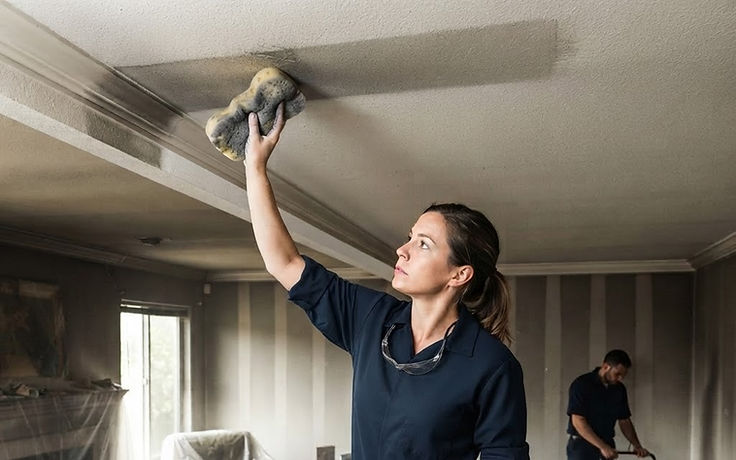
Look at a smoke-damaged room from below and you can read the fire like a tide line. Soot deposits thickest where the smoke pooled and cooled: ceiling planes, crown profiles, the tops of door casings and the inside of light fixtures.
The sequence, in order
- 1Dry removal first. Chemical sponges on ceilings and trim, no water at all.
- 2HEPA vacuum every surface and every crevice, including the tops of doors and inside cabinets.
- 3Wet cleaning with a pH-matched cleaner, working ceiling to floor so drips do not re-soil clean surfaces.
- 4Seal porous surfaces with a shellac-based primer, which locks residual odour into the substrate.
- 5Finish coat, then verify by nose at the end of the day, not immediately after.
Light fixtures and vents
Soot collects inside recessed cans and register boots, and both are pathways into cavities. They have to be removed, cleaned and reinstalled — not wiped in place. This is quiet, careful work, and it is the difference between a restored room and a repainted one.
Why the ceiling is the whole smell
Smoke rises, cools against the ceiling, and deposits a wet sooty film there before it settles onto anything else. That film is acidic, which is why it etches metal and dulls paint within days. It is also the reservoir that keeps a room smelling like a fire long after the walls have been washed. Ceilings and crown molding are the last surfaces people clean and the first surfaces that need it.
Crown molding makes it worse because it is a shelf. The top edge of the molding collects soot, and the profile has a crevice where the smoke condenses and cannot be reached with a rag. Cleaning the flat ceiling surface and leaving the molding profile is the single most common reason a fire odour persists.
The sequence that removes it
- 1Dry-remove the loose soot with a HEPA vacuum and a chemical sponge, working from the ceiling down so you do not re-contaminate the walls.
- 2Wet clean with a degreasing solution in small sections, changing the water often. A dirty rag just moves the film.
- 3Detail the crown profile with a soft brush and cotton swabs, then wipe the top edge where soot sits.
- 4Seal with a shellac-based primer. Paint alone will let the soot bleed back through within weeks.
- 5Run hydroxyl or ozone treatment for the volume after the surfaces are clean, never before.
Do the ceilings have to be painted?
In most fire losses, yes, at least a primer and usually a finish coat to match. The seal is what stops the odour and the yellowing. On a textured or plaster ceiling, the sealcoat also prevents the texture from holding soot particles that keep releasing smell.
What about the hvac system?
If the system ran during the fire, it distributed soot into every room and coated the filter, the blower and the coil. Ceiling cleaning without an HVAC scope is a partial job, and the first heating cycle will bring the smell back from the ducts.
How you know the ceiling is actually clean
Clean is judged with a white cloth and a black light. Wipe a two-foot square with a clean white rag and look at the rag: any grey on it means the film is still there. A UV light on the ceiling shows the protein and grease residue that looks invisible in daylight, particularly on a kitchen fire, and it is the check that separates a finished ceiling from a finished-looking one.
Then the smell test, done correctly. The room should be closed for a few hours, then opened, and the first breath inside the doorway is the honest reading. A room that smells clean when you have been working in it for eight hours is a room your nose has stopped noticing.
Why the trim gets cleaned twice
Crown molding, casing and baseboards are detailed profiles, and a rag follows the face but not the crevice. The first pass removes the film from the visible profile, and the second pass goes into the recess with a soft brush and a cotton swab. Skipping it leaves a line of soot in the one place a dark line is most visible, and it keeps releasing odour into the room.
The same applies to door heads and window casings, which collect soot on their top surfaces where nobody looks. It takes time and it is the detail that separates a room that is clean from a room that reads clean in daylight and smells wrong in August.
Soot cleaning and odour work in Tacoma: 425 390 5911.
- Fire damage
- Soot
- Tacoma
- Interior cleaning

