
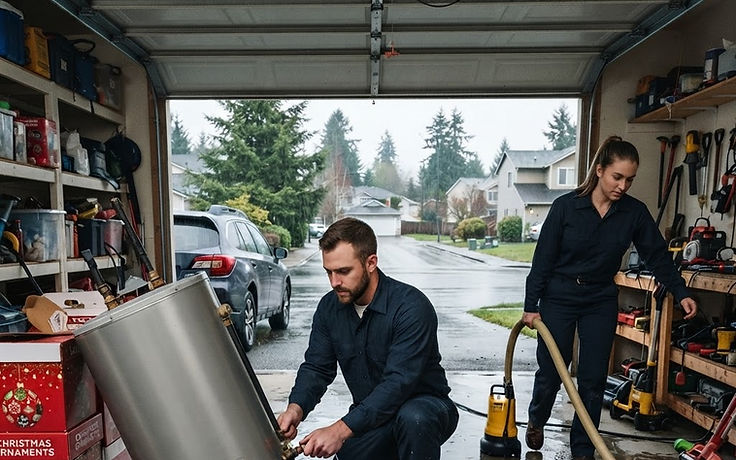
A tank water heater rusts from the inside out, and the last thing that happens is the seam or the tank wall giving way. There is no gradual warning. One afternoon the bottom drops out, 50 gallons hit the floor in under a minute, and the cold supply keeps feeding it until somebody closes the valve.
The first two minutes
- 1Close the cold inlet valve on top of the tank, or the main if the valve is frozen.
- 2Shut off the gas valve or the breaker feeding the unit.
- 3If the heater is in a garage or utility room, clear the floor and make sure water is not reaching the furnace or panel.
- 4Photograph the tank, the data plate and the water line before cleanup begins.
What the water does after it lands
In a garage, the damage is usually to stored contents and the bottom plate of the wall framing, which wicks water upward into the drywall. On a finished floor, water spreads under vinyl and into the adjacent room within minutes. Either way, standing water needs extraction the same hour, because the difference between a two-day dry-down and a full flooring replacement is measured in hours.
Replacing the tank without repeating this
If the tank sits in a finished space, put it in a drain pan with a line to a drain. Change the anode rod every four to six years; that single part is what determines whether the tank lasts twelve years or twenty. And consider a leak-sensing shutoff on the inlet, which is inexpensive and pays for itself the first time it works.
The two minutes that decide the loss
A tank does not fail gradually. The lining rusts through at the bottom, the tank lets go, and 40 to 80 gallons leaves the tank in seconds. Then the cold water inlet keeps refilling it, so a failed tank will keep discharging until the supply is shut off. That refill is the difference between a wet garage floor and a garage with four inches of standing water at the door.
In a Puyallup garage the water then does three things: runs under the wall into the house if the garage slab is lower than the living room, soaks the bottom plate of the shared wall, and finds the garage door threshold, where it runs into the driveway and away. The first two matter. Water under a baseplate wicks up into the framing and into the drywall on the inside face.
Shut it down in this order
- 1Close the cold inlet valve on top of the tank. If it will not close, shut the house main.
- 2Kill power at the breaker. On a gas unit, turn the gas valve to off. A dry-fired element burns itself out in under a minute.
- 3Drain the tank with a hose to a floor drain if you can, which stops the last 40 gallons from landing on the floor.
- 4Move anything stored on the garage slab out of the water, especially cardboard, paint and power tools.
- 5Photograph the tank label and the failure point. The adjuster needs the age and the model.
Do I need a new tank or a tankless unit?
For a straight burst replacement, a new tank in the same location is the fastest path back to hot water. If you have been considering tankless, do it in the same project, but plan the venting and gas capacity first. A tankless unit that shares an existing flue often needs a new vent through the roof.
How long does the garage take to dry?
A concrete slab with water on it dries in a day or two with air movement. The baseplate, the framing above it and the drywall on the house side are the slow parts, and they typically need three to four days of measured drying before they read dry against a reference.
What a garage tank burst costs, and what insurance covers
The extraction and drying on a garage slab is a small job: a day of equipment and a couple of days of readings, usually under 1,200 dollars. The variable is the shared wall. If water ran under the baseplate into the house-side drywall, that wall gets opened, dried, and rebuilt, and the number moves into the several thousands.
On coverage, a burst tank is normally sudden and accidental and the resulting water damage is covered. What is excluded is the tank itself, which is maintenance. Contents stored on the garage floor are covered under the personal property portion of the policy if they were damaged by the water, which is why the photograph of what was sitting on that slab matters.
One item to raise with the adjuster and the plumber at the same time: an expansion tank and a pan with a drain. On a replacement in the same location, both are cheap to add and both are the reason the next failure is a hiss rather than a flood.
Emergency water response in Puyallup and South Hill: 425 390 5911.
- Emergency
- Water heater
- Puyallup
- Pierce County

