
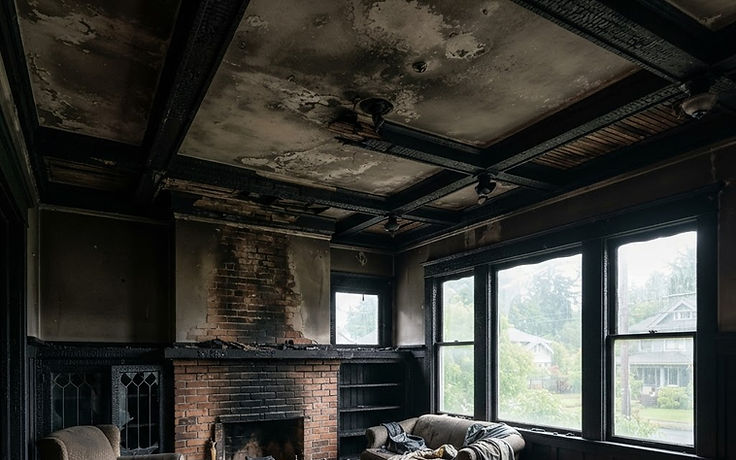
A house fire is a fire for about twenty minutes and a smoke problem for six months. In Historic Downtown Snohomish — where the housing stock dates to the 1890s — the smoke problem is closer to a year unless it is handled properly.
We have restored fire losses in everything from a 1901 Victorian off Avenue D to a 2019 build in Mill Creek, and the two jobs have almost nothing in common. Here is what makes historic fire restoration different, and what to insist on.
Balloon framing is a smoke chimney
Old homes are often balloon-framed: studs run in continuous vertical channels from the foundation to the roof, with no fire blocking. That is a straight vertical shaft from the basement to the attic, and smoke uses it as an express lane. It also means smoke residue collects in wall cavities that have no visible connection to the fire room.
If your contractor cleans only the rooms that burned, you will smell smoke in a bedroom on the third floor next February when the heat comes on.
Soot is acidic, and it etches
Protein-based smoke from a kitchen fire leaves an almost invisible film that is highly acidic. Within 72 hours it begins to pit brass hardware, etch glass, dull chrome and permanently stain finished wood. Within a week it is irreversible without refinishing.
This is why the first 24 hours matter more than any other part of a fire loss. Board-up, soot removal and odour treatment happen immediately, not after the adjuster visits.
Lath and plaster: clean it, do not replace it
Plaster walls can usually be cleaned and sealed rather than replaced — which matters enormously on a historic property where the wall profiles and trim are irreplaceable. The sequence is dry-soot sponging first (chemical sponges, no water), then wet cleaning with a pH-appropriate agent, then sealing with a shellac-based primer that traps residual odour.
Skipping the shellac primer is the number one reason a fire restoration "still smells". Latex paint will not seal smoke odour in plaster. Shellac will.
Odour is a chemistry problem, not a fragrance problem
Smoke odour molecules lodge in porous materials — insulation, upholstery, wood, drywall paper. Masking them with ozone or fragrance fails within weeks. The only durable solutions are removal of the material, or oxidation treatment of the entire volume.
- Thermal fogging — a solvent-based fog that penetrates the same pathways smoke did and neutralises odour molecules.
- Hydroxyl generators — safe for occupied spaces, run for 24–72 hours to oxidise residual odour.
- Duct and HVAC cleaning — otherwise the first heating cycle re-contaminates every room.
- Contents treatment — textiles, upholstery and books hold odour longer than the structure does.
Contents: the part most companies get wrong
In a historic Snohomish home, the contents often outweigh the structure in value — antiques, original art, family documents, a piano. Our pack-out team inventories every item by room, photographs and barcodes it, and cleans by material type: ultrasonic for hard goods, specialised dry cleaning for textiles, and documentation recovery for paper.
Those items live in our Bellevue warehouse, climate-controlled and alarmed, until your rebuild is finished. Then they come back to the right rooms.
Rebuilding to match, not to modern
Slapping modern drywall into a 1890s interior is visible from across the room. We source matched millwork profiles, replicate plaster texture, and where the original trim cannot be saved, we have it milled. It takes longer. It is the difference between a repair and a restoration.
What to do in the first hour after a fire
- 1Get everyone out and call 911. Nothing on this page matters more than that.
- 2Do not re-enter until the fire department says it is safe. Structural damage after a fire is not always visible.
- 3Do not run the HVAC system. It will distribute soot through the entire house.
- 4Photograph everything you can see from doorways before anything is moved.
- 5Call 425 390 5911 for emergency board-up and soot stabilisation. We can be on site in Snohomish County in under 30 minutes.
Working with a preservation office and a preservation-minded adjuster
A historic home in Snohomish County is often inside a district with design review, which changes the rebuild rather than the cleanup. Siding profile, window configuration, trim and roof material may all need approval, and a carrier estimate written for modern materials will not match what the district will allow. Getting that conversation started on day two avoids a rebuild that stops on day twenty.
The second conversation is with the adjuster about matching. When original millwork, plaster cornice or a period window is damaged, replacement in kind is either unavailable or enormously expensive, and many policies include an ordinance or law provision that covers the cost of meeting code and design requirements. Those provisions are not automatic; they get applied when someone asks and documents the requirement.
Can smoke damage be cleaned from original plaster cornice?
Usually yes. Plaster cornice is cleaned with a chemical sponge first, then a dry-cleaning putty that lifts soot out of the profile, then a sealcoat. Removing and recasting a run of cornice is a specialty trade measured in weeks, so cleaning almost always wins on cost and on preservation.
What about the original windows?
Sash, jambs and glass all take smoke differently. Glass cleans, hardware is replaced or refinished, and the sash is cleaned and sealed. Replacing original windows because they smell is a design review problem and a preservation loss, so we clean first and document the result.
Fire claims are complex, and 99.9% of the ones we document are approved — largely because we photograph and itemise aggressively from hour one. If you are standing in front of a burned house right now, call. We will walk you through it.
- Fire damage
- Snohomish
- Historic homes
- Smoke odour

