

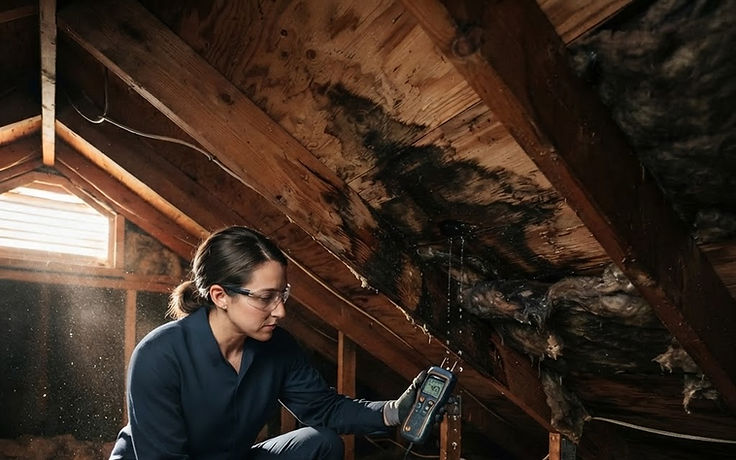
A roof valley collects water from two planes and delivers it to one line. That makes it the highest-flow, highest-stress detail on the whole roof, and it is the detail most often installed wrong. Under heavy fir canopy in Woodinville, add a decade of needles and moss and the valley becomes a dam.
Why you never see the stain
Water entering at a valley runs along the top of the underlayment or the sheathing until it finds a nail, a joint, or the edge of a sheet, then it drops into the insulation. From there it wicks along the insulation rather than falling. It can travel ten feet sideways before it finds a way through the ceiling drywall, and by then nobody associates it with the roof.
What we check and in what order
- 1Thermal scan of the ceilings below every valley and penetration, looking for cold anomalies.
- 2Pin meter on the attic sheathing along the valley line, grid pattern, every two feet.
- 3A look at the valley metal and underlayment from the roof surface, if it is safely accessible.
- 4Gutter and downspout condition, because a backed-up gutter pushes water under the first course.
Repair order matters
Dry the structure first, then fix the roof, then close it back up. We have seen far too many homes where the ceiling was patched, the roof was patched, and the wet insulation was left in place. That is a mold farm above a fresh coat of paint.
Why a valley leak hides for years
A valley is where two roof planes meet and where two planes worth of water arrive at once. If the valley metal is under-driven, the underlayment is lapped the wrong way, or a nail from the shingle course above lands in the wrong place, water enters the roof assembly and then does something unhelpful: it runs along the top of the underlayment, or down a rafter, or into the sheathing, until it finds a low point. That low point is often 10 feet from the entry.
By the time a stain shows on a ceiling, the sequence behind it has been running for months: wet sheathing, then a wet bat of insulation, then a wet ceiling board. A Woodinville home under Douglas firs adds a second problem. Needle litter in the valley holds water against the shingle surface after the rain has stopped, which means the leak keeps running for hours after the storm passes.
What we inspect and in what order
- 1Attic first: look for sheathing staining, and read the rafters with a pin meter along their length rather than at one spot.
- 2Trace the path uphill from the stain. Water almost never enters where it exits.
- 3Check the valley metal laps, the step flashing at any wall that meets the valley, and the shingle course above.
- 4Look at the insulation: a compressed or displaced bat is a signature of a long-running leak.
- 5Confirm with a hose test on a dry day if the attic reading does not match the ceiling stain.
Does the roofer or the restoration company go first?
The leak gets stopped first, even if it is a temporary tarp, because drying a house under an active leak is a losing effort. Then the interior dries. Then the roofer returns for the permanent repair. Doing the permanent repair before the interior is dry is fine; doing nothing about the interior while the roofer waits for materials is how a leak becomes a mold project.
Is it worth claiming?
Roof leaks are often excluded as a maintenance failure, but the resulting interior damage is frequently covered when the leak was sudden and not long-term. The documentation that decides it is the moisture map showing how far the water travelled and the photos of the failed detail. That is exactly what we produce on the first visit.
What a valley leak costs if it is caught in year one versus year five
Caught early, a valley leak is a tarp, a roofer repair of the flashing and underlayment, a small section of insulation, and a plaster or drywall patch: 1,500 to 4,000 dollars depending on the roof pitch and the interior finish. Caught in year five, the sheathing over that valley is soft, two or three rafters have decayed at their upper end, the insulation is a contaminated mat, and the ceiling has a mold colony on the back face. That is a roof section replacement, framing repair and a room rebuild.
The difference between those two outcomes is not the roof age. It is whether anyone looked in the attic after the first big rain of the season. Fifteen minutes with a flashlight and a pin meter in October, on the deck below every valley, is the cheapest inspection a Woodinville homeowner can do.
Roof leak diagnostics in Woodinville and the eastside: 425 390 5911.
- Roof leak
- Attic
- Woodinville
- Water damage

