
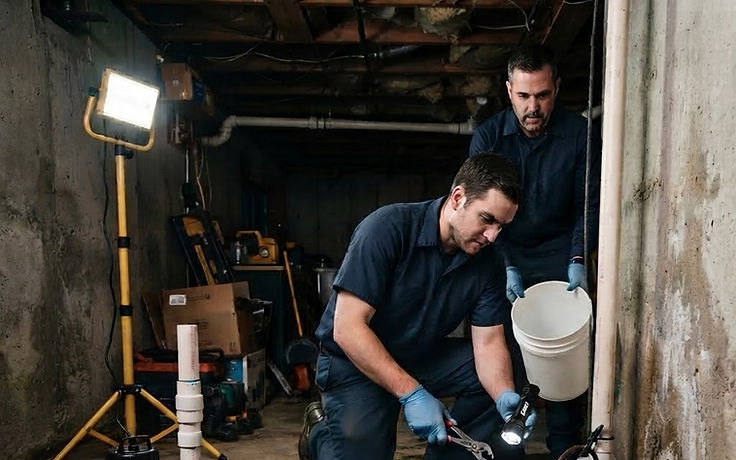
A sump pump is a machine with a float switch that sits in water, sediment and grit for years at a time, then is asked to run continuously for six hours during a storm. Its service life is roughly seven to ten years. Most fail exactly when the house needs them.
Test it in October
Pour a bucket of water into the pit. The float should trip and the pump should move the water in a few seconds. If it hums without moving water, the impeller or the check valve is stuck. If it does nothing at all, the float or the switch has failed. Either way, you want to discover that on a Sunday afternoon in October, not at 1 a.m. in a downpour.
What a correct installation includes
- A pit that is actually deep enough, lined, and clear of gravel and silt.
- A check valve on the discharge line so water does not drain back into the pit.
- A discharge line that empties well away from the foundation, not four inches from it.
- A battery backup, because storms that flood basements also take out power.
- A high-water alarm, which is the cheapest early warning available.
Why it fails on the night you need it
A sump pump sits idle for ten months and then runs continuously for six hours during a storm. That is the worst duty cycle any appliance can have. The float sticks because it has not moved, the check valve has mineral build-up, the discharge line has frozen or been crushed, and the backup battery has been dead since last winter without anyone noticing.
In Tacoma, the storm that fills a sump pit is usually the same storm that takes out the power, which is why a pump with no battery backup fails exactly when the water arrives. A basement that floods during an outage is not bad luck, it is an untested backup.
What a reliable setup includes
- A cast iron or stainless primary pump rated for the pit depth and the head height of the discharge run.
- A battery backup pump on a separate float, with a battery that is load-tested twice a year, not just checked for voltage.
- A check valve that is actually rated for the discharge, and a discharge line that leaves the house above the frost line.
- A pit lid and a high-water alarm, so a failure makes a noise before the carpet does.
- A clear gravel base in the pit, so the pump does not lift silt and jam the impeller.
How often should it be tested?
Pour a bucket of water into the pit twice a year, in October before the wet season and in March. Watch that the float lifts, the pump starts, the water level drops and the pump stops. Ten minutes, twice a year, is the entire maintenance routine.
What if my basement floods anyway?
Stop the inflow if you can, move contents off the floor and photograph everything before you touch it. Water from a sump is groundwater and typically category 2, which changes what can be dried and kept. Call dispatch, because a finished basement is a same-day job.
What a failure actually costs, and what the policy does with it
A failed sump pump on a finished Tacoma basement is one of the more expensive small failures in a house: extraction and drying of the floor, removal of saturated carpet and pad, cutting the drywall base, drying the framing, then the rebuild. Typical totals land between 12,000 and 35,000 dollars depending on how long the water ran and how much of the basement was finished.
On coverage, the answer depends on the endorsement. Water that backs up through a drain or seeps through a foundation is usually excluded unless the policy carries a water backup endorsement, and a sump overflow is often treated the same way. That endorsement costs a small amount per year and is the only reason those claims get paid.
The other variable is duration. A pump that fails on a Saturday with the family home is a few hours of water. A pump that fails while the house is empty for a week is a different claim entirely, which is why a high-water alarm that texts is worth more than the pump upgrade.
How long a pump actually lasts
A cast iron pump in a clean pit lasts seven to ten years. In a pit that lifts silt, that drops to five, because grit wears the impeller and the seal. A battery backup battery has a service life of three to five years regardless of how little it is used, which is why the battery is the item that fails quietly. If a homeowner does not know the age of either, both are due.
The replacement decision is simple arithmetic. A pump and battery installed is less than a single deductible on a basement flood, and the pump is also the smaller disruption. Replacing a working pump a year early costs a few hundred dollars, and that is the direction we recommend when the age is unknown.
Basement water response in Tacoma: 425 390 5911.
- Prevention
- Sump pump
- Tacoma
- Basements

