
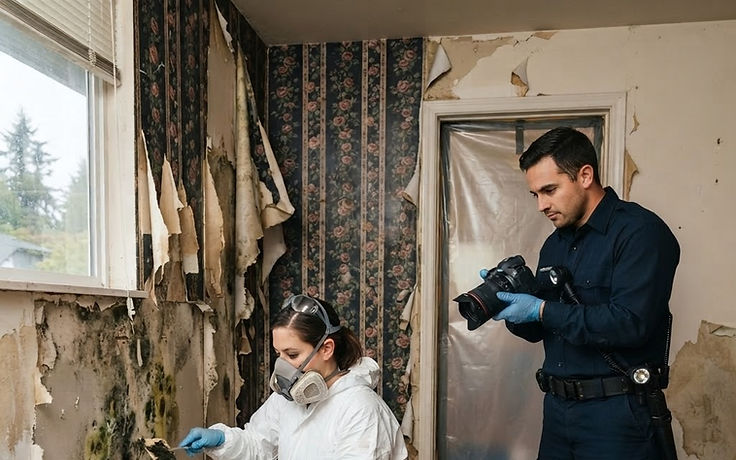
Wallpaper is a vapor retarder glued to the wall. In a room where humidity runs high, the paper stops the wall from drying inward, and any moisture inside the assembly condenses on the back of the paper where the mold has a food source, a surface and no air movement.
Early signs, before anything is visible
- Seams lifting at the bottom of a wall, especially on an exterior wall.
- A musty smell in one particular room that does not follow the weather.
- Paint or paper that feels slightly soft, or a dark shadow showing through light paper.
- Bubbling around outlets and switch plates, which are holes in the vapor barrier.
What we do about it
We test the wall with a non-invasive meter and a thermal camera first, so we know how far the moisture field extends before anything is removed. Then containment, removal of the affected paper and any compromised drywall, HEPA vacuuming, antimicrobial treatment, and drying to a measured standard. Only then does the wall get finished again.
Why wallpaper is a moisture trap, not a finish
Wallpaper goes on with paste, and paste is starch. Starch is food. The paper itself is a vapor retarder, so when a wall gets damp from the outside, from a plumbing leak inside the cavity, or from condensation on a cold exterior wall, the moisture arrives and then cannot leave through the surface. It dries inward through the drywall instead, and the paper face of the drywall stays wet behind the paper.
That is why the visible damage so often starts at the edges: at a seam, above a baseboard, below a window where the wall is coldest. The growth starts inside the assembly and spreads across the back of the wallpaper, and the first thing the homeowner notices is that the seam has lifted.
Early signs, before anything is visible
- Seams lifting or curling in a room that has not been redecorated for years.
- A musty smell that is strongest in one room and absent in the hallway.
- Paper that sounds different when tapped: dull over a wet patch, crisp over a dry one.
- Paint or paper darkening near an exterior corner or below a window sill.
- A cold wall in winter with condensation on the paper at the bottom of the room.
Does the wallpaper always have to come off?
If growth is behind it, yes, and in the affected area plus a margin. Wallpaper cannot be cleaned on its back face. What we can usually save is the drywall underneath: the paper face is removed, the board is dried and treated, then skimmed and repainted, which is cheaper than replacing the wall.
What causes it in a Seattle house with no leak?
In older Seattle homes, the usual cause is a wall that is thin on insulation, so the interior surface sits below the dew point all winter. Every shower, every pot of water on the stove, every load of laundry adds humidity that condenses on that wall. The fix is insulation plus ventilation, and the paper coming off is the only way to get there.
What the removal and repair actually costs
A single affected wall in a Seattle bedroom is a small remediation: containment, removal of the paper and the affected paper face, treatment, drying, then skim and paint. That usually lands between 1,200 and 3,000 dollars depending on the wall length and how much board has to come out. A room with three exterior walls affected is a bigger job, and the number moves more with the finish work than with the remediation.
The repair matters as much as the cleanup. Taking the paper off, fixing the moisture path and then rehanging wallpaper over the same cold wall is a repeat. On a wall that runs below the dew point all winter, the honest finish is paint over a sealed surface, or insulation and a vapor strategy behind the finish, which is a different project and worth planning as one.
Can the wallpaper go back up afterwards?
On an interior wall that was only affected by a one-time event, yes, once the wall is dry and treated, and a breathable paste is used. On an exterior wall in a Seattle house, the honest recommendation is usually to leave it painted, because the wall will run below the dew point again and a vapor-retarding paper will trap the same moisture in the same place.
If the period look matters, a breathable wall covering over a properly insulated and sealed wall is the version that holds. The order is insulate, seal, ventilate, then decorate, and doing the decorating first is how the room gets paid for twice.
Mold assessments across Seattle: 425 390 5911.
- Mold
- Wallpaper
- Seattle
- Interior walls

