

Every winter we run a burst-pipe surge across Kitsap County. Bremerton, Poulsbo, Port Orchard and the rural edges of Bainbridge all freeze harder than Seattle does, and a lot of the housing stock has plumbing in unheated crawlspaces and exterior walls.
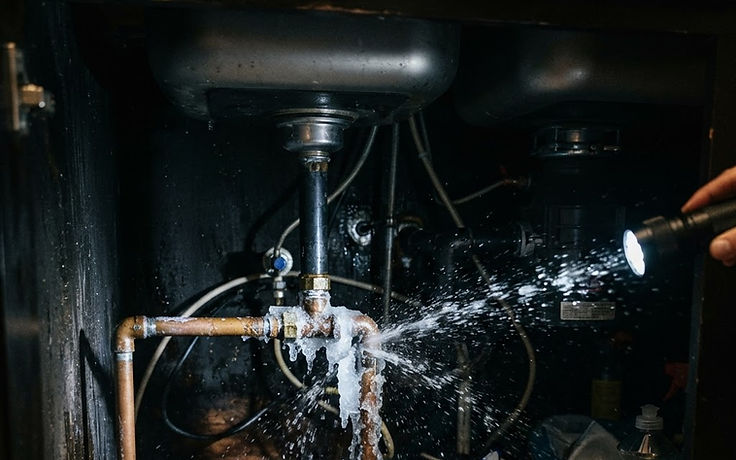
A burst pipe releases water at 4 to 8 gallons a minute. In the six hours between 2 a.m. and 8 a.m., that is somewhere between 1,400 and 2,900 gallons inside your home. The response sequence in the first ten minutes decides almost everything.
Why pipes in Kitsap freeze more often
- Crawlspace plumbing. A large share of Kitsap homes have supply lines running through vented crawlspaces that drop below freezing.
- Exterior wall runs. Older homes often have kitchen and bathroom plumbing in exterior walls with minimal insulation.
- Wells and pump houses. Rural properties on Bainbridge and in South Kitsap have unheated pump houses.
- Power outages. Windstorms take out power, heat stops, and the house cools for 20 hours. A 2019-style windstorm is a mass freeze event.
The 2 a.m. sequence — in order
1. Kill the water at the main
Not the fixture valve. The main. In Kitsap, that is usually in a crawlspace, a garage, or a utility closet. If you are on a well, shut the pump breaker off first, then close the valve. If you cannot find the main in the dark, call 425 390 5911 and our dispatcher will talk you through locating it — we do this several times a week.
2. Kill power to affected rooms
Water in a ceiling above a light fixture is a fire hazard the moment the switch is flipped. Turn off the circuit at the breaker panel for any room with water on the floor or in the ceiling.
3. Do not try to thaw the pipe with a torch
Every year, someone burns a house down doing exactly this. A propane torch in a crawlspace with 60-year-old insulation and dry framing is the leading cause of freeze-related house fires. Use a hair dryer on the lowest setting, a heat lamp, or warm towels — and only on a pipe you can see and reach safely.
4. Open the nearest faucet
If a pipe is frozen but not yet split, opening the faucet gives the melting ice somewhere to go and can prevent a pressure build-up. If the pipe has already split, closing everything and shutting the main is the priority.
5. Get water out of the carpet now
Towels and a wet-dry vac buy real time. Pull the carpet edge up, get the pad out if it is saturated, and get furniture onto blocks. Anything you remove, photograph first.
6. Start the documentation
Video walkthrough, photos of the split pipe, photos of the water line on the wall. Note the time you shut the water off. This file is what your claim is built on.
The three mistakes that make it worse
- 1Running a fan or turning the heat up. Heat raises moisture capacity without removing water; it drives humidity into wall cavities and other rooms.
- 2Waiting until morning to call. A six-hour delay in freezing conditions is often the difference between a dried floor and a replaced one — and the water keeps flowing if the main is not closed.
- 3Assuming the insurance will not cover a frozen pipe. In Washington, a burst pipe from a freeze event is typically covered as sudden and accidental damage. What is usually excluded is the damage that results from the home being unoccupied and unheated for an extended period — check your vacancy clause, not your freeze clause.
How to prevent the next one
Before the first hard freeze: disconnect and drain garden hoses, close interior valves to exterior spigots, insulate every accessible crawlspace supply line with foam sleeves, seal foundation vents on the windward side, and set the thermostat to at least 55°F whenever you leave — even for a weekend. If your home has a crawlspace with exposed copper, that insulation job takes two hours and costs less than your deductible.
Our Kitsap crews stage out of Bremerton, so the ferry schedule never gets between us and your address. Bremerton, Silverdale, Poulsbo and Port Orchard are all inside our 30-minute window, and Bainbridge is too.
Thawing a frozen pipe without splitting it
A frozen pipe is not a burst pipe yet, and the way you thaw it decides whether it becomes one. The mechanical danger is thermal shock: pouring boiling water on a below-freezing copper line or running a torch along it changes the metal fast enough to crack a joint or ignite framing. Slow and warm is the only method that is safe and repeatable at two in the morning.
Start at the fixture end, not the middle. Open the nearest faucet so there is somewhere for the water to go, then warm the coldest accessible section with a hair dryer on high, moving continuously, or with a heat lamp held well back. Work backward toward the main in short sections, and stop the moment water runs: the pipe is open, and the rest of the line is behind it.
How do I know if it is frozen or already split?
If the pipe is bulged, deformed or weeping, it has split. If it is cold and silent with no flow, it is likely just frozen. Either way the main stays off until you can see the whole run, because a split that is thawed while the main is open delivers full-flow water into a wall cavity within seconds.
Will a hair dryer reach a pipe inside a wall?
Sometimes through an access opening, a cabinet back, or a register. If the frozen section is not accessible, the honest answer is to keep the main off until a plumber can open the wall. Drilling exploratory holes yourself in a wall full of wiring is how a plumbing problem becomes an electrical one.
If your pipe has already let go, stop reading and call 425 390 5911. We are awake.
- Frozen pipes
- Kitsap County
- Bremerton
- Emergency response

