
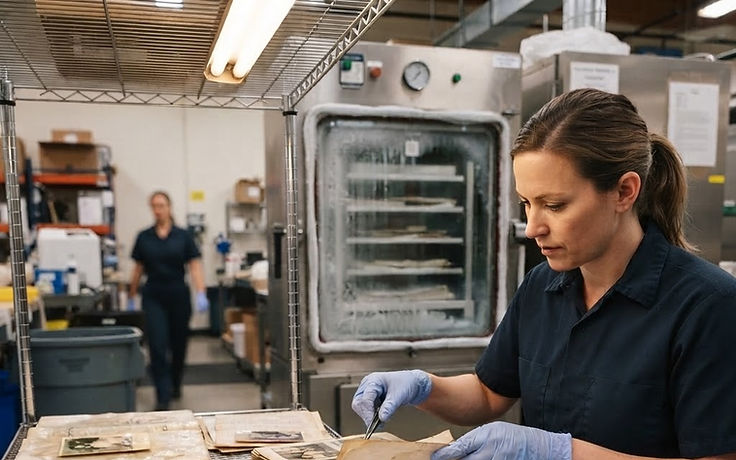
Paper is more resilient than people assume and far less forgiving of delay. A wet document left in a stack for two days becomes a solid block with mold growing between the pages. A wet document frozen within about 48 hours can usually be recovered almost perfectly.
Why freezing works
Freezing stops mold growth and locks the pages in place. Then, in a vacuum chamber, the ice sublimates directly to vapour rather than passing through a liquid stage, so the paper avoids the swelling and cockling that air drying causes. Ink, toner and most photographic emulsions survive it.
What to do in the first hour
- 1Do not separate pages. Do not try to fan a soaked book or album.
- 2Interleave nothing, and do not stack wet documents on top of each other.
- 3If you have freezer space, bag the items and freeze them at home as a holding action.
- 4Call and tell us you have documents, so the right equipment is on the first truck.
Why paper cannot simply be dried
Wet paper does two things at once. The fibres swell, and any ink that is water-soluble starts to migrate. Air drying a wet stack of documents fuses the pages into a block as the fibres bond, and heat drives the ink further into the sheet. That is why a box of wet tax records, if left on a shelf for two days, becomes a brick that cannot be read even after it dries.
Freeze-drying works because it removes the water without ever letting the paper pass through a liquid-to-air evaporation phase. Documents are frozen within 48 hours, which stops the migration and the mould, and then sublimated under vacuum so the water leaves as vapour from the ice.
What the process looks like in practice
- 1Triage within 48 hours: separate coated paper, photographs, bound books and thermal prints, which all behave differently.
- 2Pack and freeze, interleaving with freezer paper so pages do not bond in the chamber.
- 3Chamber loading and a vacuum cycle that typically runs one to three weeks depending on the thickness of the stack.
- 4Post-treatment assessment: readable, stained but readable, or unrecoverable, documented page range by page range.
- 5Return in archival boxes, with the digital copy if the item was scanned on the way through.
What about photographs?
Glossy prints have a gelatin emulsion that sticks when wet and cannot be separated if they were stacked wet. Prints that were separated when wet freeze-dry beautifully. Negatives and slides are the most recoverable of all. Scan them first if they are readable, because a digital copy is not a restoration risk.
How much does it cost?
Freeze-drying is priced by volume, typically a few hundred dollars per box of documents for a chamber cycle. It is worth it for deeds, titles, medical records, immigration papers and family photographs, and it is not worth it for items you would replace anyway.
How to pack a box of wet documents in the first hour
Do not try to separate wet pages. Pick up the stack as it lies and put it in a plastic bag, then into a freezer if you have space, because a domestic freezer at 0 degrees stops mould and buys days. Interleave nothing, add nothing, and label the bag with what it is and where it came from. Freezer paper between groups is fine if the documents were already separated, but forcing pages apart tears the ones that matter most.
If there is no freezer space, lay the documents flat on a dry surface in the coolest room in the house with a fan moving air across, not into, the stack, and call for a chamber slot the same day. What you must not do is stack them, weigh them down, or put them near a radiator, and you must not try to peel a photograph off another photograph.
Priorities, in order: identification, deeds and titles, financial and medical records, photographs, then everything else. If a box contains a mix, the box goes to the chamber and gets sorted after it is dry, because sorting wet paper costs more than drying it.
What comes back, and what it looks like
Documents come back as documents: readable, slightly stiff, sometimes with a tide line where the water had reached. Photographs come back with the emulsion intact or, in the worst case, with a slight texture change in the gloss. Bound books come back with pages that separate cleanly, though a spine that was already failing may not survive.
What does not come back is anything that was stacked wet and left for a week, or anything with water-soluble ink that spent three days soaking. That is the honest answer to the question, and it is why the phone call in the first hour matters more than the equipment in the chamber.
Document and photo recovery in Seattle: 425 390 5911.
- Contents
- Documents
- Seattle
- Water damage

